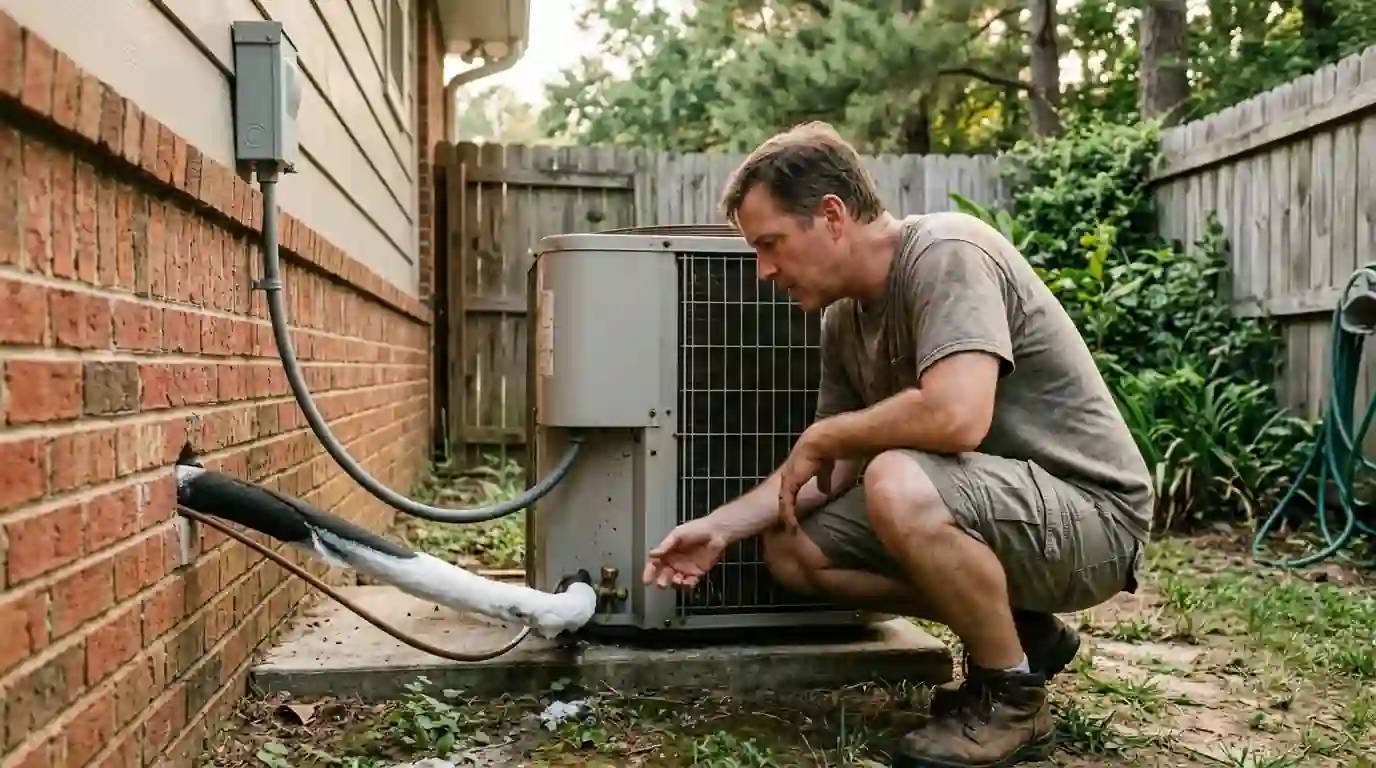
What ice on an air conditioner is telling you
An air conditioner is supposed to run cold, but not that cold. The indoor coil works best just above freezing, where it pulls heat and water out of the house air at the same time. When the coil drops below 32 degrees, the water it collects freezes on the fins instead of draining away.
Ice then feeds on itself. A thin layer of frost blocks some of the air moving across the coil, so the coil gets even colder and more ice forms. Within hours a light frost can become a solid block, and the house stops cooling while the system keeps running.
You may see frost on the larger insulated copper line at the outdoor unit, on the line where it leaves the indoor unit, or water pooling near the furnace or air handler. Weak airflow from the vents and air that feels only slightly cool are often the first clues. Nearly every case comes back to one of two things: too little warm air reaching the coil, or too little refrigerant inside it.
What to do the moment you find ice
Turning the system off quickly protects the compressor and limits the mess. These steps are safe for any homeowner, and none of them involve opening the equipment.
- Switch the thermostat from cool to off. This stops the compressor, so no more ice forms.
- Set the fan to on. Moving room air across the coil melts the ice faster than leaving everything off.
- Check the filter. If it is gray, matted or bowed, replace it now so airflow is ready for the restart.
- Put towels down near the indoor unit. Melting ice sends a lot of water to the drain pan at once.
- Leave the ice alone. Chipping or scraping at it can puncture the coil or a copper line.
- Wait for a full thaw. Light frost clears in an hour or two. A thick block can take most of a day.
Once the lines and the indoor unit are dry, set the thermostat back to cool at a normal setting and watch it for a few hours. If frost returns, turn it off again and call us. Running a system that keeps freezing can send liquid refrigerant back to the compressor, which costs far more to fix than whatever caused the ice.
Airflow problems that freeze the coil
Most freeze-ups start with air that can't get across the coil fast enough. The refrigerant keeps the coil cold, but too little warm air arrives to balance it.
A clogged filter
A loaded filter is the first suspect and the easiest fix. Birmingham's spring pollen coats everything yellow-green in March and April, and a 1 inch filter can fill within a few weeks. Pet hair and renovation dust do the same thing even faster. If you can't remember the last change, start here.
Closed or blocked registers
Closing vents in unused rooms seems like a way to save money, but it raises pressure in the ducts and cuts total airflow. A sofa pushed against a return grille, or a rug over a floor return, has the same effect. Keep supply registers open and return grilles clear.

A weak blower or a dirty blower wheel
The blower in the air handler moves all of that air. A failing motor, a weak capacitor or a wheel caked with dust spins slower than it should. The system sounds normal from the hallway, but every register blows a little softer than it used to.
A matted coil or crushed ducts
Dust that gets past the filter builds up on the face of the indoor coil and acts like a second, dirtier filter. In the attic or crawlspace, a crushed flex duct or a disconnected return can choke airflow too. These need a technician to find and correct, usually with a static pressure reading.
Low refrigerant means there is a leak
An air conditioner doesn't use up refrigerant the way a car burns gas. The charge is sealed in a closed loop, so a low charge almost always means a leak somewhere. With less refrigerant in the loop, pressure in the coil falls, the coil temperature falls with it, and ice forms even with a clean filter.
Leaks often hide at brazed joints, in the indoor coil, at the service valves or where a line rubs against something. An oily spot on a fitting, a hissing sound or ice that returns within a day of a filter change all point this way. Adding refrigerant without finding the leak only buys a few weeks or months.
Refrigerant work is never a homeowner job. Older systems that run on R-22 cost much more to recharge, because production ended in 2020. A refrigerant leak repair finds the leak, fixes it and charges the system by weight. On an older R-22 unit, we will tell you if replacement makes more sense.
Cool nights and very low thermostat settings
Birmingham gets plenty of mild nights in spring and fall, warm enough to run the AC in the afternoon but cool after dark. If the thermostat sits very low on one of those nights, the system keeps running with little heat in the house to absorb. The coil can drift below freezing even when nothing is broken.
Oversized systems are more prone to this, and so are systems with a marginal filter or a slightly low charge. Keeping the setting in the upper 70s, and raising it rather than lowering it on cool nights, keeps the coil in its normal range. The DOE suggests about 78 degrees when you are home in summer.
If the AC only freezes on cool nights and works fine on hot afternoons, mention that when you call. That one detail narrows the list of causes quickly.
Water after the thaw: watch the drain pan
A frozen coil holds a lot of water. When it melts, that water hits the drain pan much faster than normal condensation does. If the condensate line is partly clogged with algae, the pan can overflow, and an attic unit can stain the ceiling below.
Many attic and closet units have a float switch that shuts the system off when the pan fills. If your AC won't restart after a thaw, a tripped float switch may be the reason. That is the switch doing its job, and the drain needs clearing before the system can run. Our guide to clogged AC drain lines covers the warning signs and the safe checks.
When a frozen AC needs a repair visit
- Ice comes back within a day, even with a clean filter.
- You hear hissing or see an oily stain on a copper line or fitting.
- Water shows up on the ceiling, the closet floor or the attic decking.
- The outdoor unit hums but its fan does not spin, or a breaker trips. Reset a tripped breaker once at most.
- The system will not restart after a full thaw.
On a freeze-up call, we check airflow first with static pressure and blower readings, then the coil, the drain and the refrigerant charge. You see what we found and the price before any work starts. Most freeze-up causes land within our typical AC repair range of $165 to $740, while a coil replacement or a large leak costs more. A person answers our line 24/7.
Key takeaways
- Ice on an AC means too little airflow or too little refrigerant, so the coil drops below freezing.
- Switch cooling off, set the fan to on and let all of the ice melt before restarting.
- Check the filter and the registers first. They cause many freeze-ups and are easy to fix.
- Ice that returns with a clean filter usually points to a leak or a blower problem, so call us.
Questions readers ask
Light frost on the lines usually clears in an hour or two with the thermostat off and the fan on. A coil packed with solid ice can take most of a day. Wait until the lines and the indoor unit are dry before switching back to cool, or the ice will rebuild quickly.
No. A frozen coil cools the house poorly, and it can send liquid refrigerant back to the compressor, which can damage it. Turn cooling off, run the fan to melt the ice and look for the cause. If ice returns after a new filter, call for a repair visit.
Yes. Closing several supply registers raises pressure in the ducts and cuts the total air moving across the indoor coil. With less warm air reaching it, the coil runs colder and can ice over. Keep registers open and return grilles clear, and ask about zoning if some rooms need less cooling.
Melting ice sends water to the drain pan much faster than normal. If the drain line is partly clogged, the pan overflows onto the floor or the ceiling below. Put towels down, keep cooling off and have the drain cleared. A tripped float switch may also keep the system from restarting.