
What a complete system price should cover
When people ask what a new HVAC system costs, they usually mean replacing both halves of a split system at once. The condenser or heat pump outside, the furnace or air handler inside, the coil that sits on it and, in most cases, a new thermostat all change together. Swapping only the outdoor unit is a different job with a different price.
Around Birmingham, most complete split systems we price land between $8,640 and $17,980 installed. Simple single-stage equipment in a one-level ranch with easy access lands toward the bottom. Variable-speed equipment, larger or two-story homes and jobs with duct changes climb toward the top. Our complete HVAC system replacement page walks through the install itself.
That range covers equipment, labor, startup and hauling away the old units. Bigger changes to the house, such as new ductwork, a panel upgrade or a new gas line, usually show up as separate line items. Seeing them split out makes it easier to tell what the house needs from what the equipment costs.
Typical Birmingham-area ranges by system type
The type of system you choose sets the starting point. These are typical installed ranges for one system in a Birmingham-area home, not quotes. Size, efficiency and the house itself move each one.
- Heat pump with a matched air handler: $6,380 to $13,940. Common in all-electric homes and newer subdivisions, with heat strips as backup.
- Central AC with a gas furnace: $8,640 to $14,260. A natural fit where Spire gas is already in the house.
- Dual fuel, a heat pump with a new gas furnace: $10,870 to $15,960. When a younger furnace can stay, the job can start closer to $5,840.
- Variable-speed equipment with duct changes: up to about $17,980 for a single system.
- Single-zone ductless mini-split: $3,780 to $6,940, for an addition or a room the ducts never reached.
Two-story homes in Hoover, Trussville and Chelsea often run one system per floor. That is really two projects priced together, though doing both on one visit saves some setup. If one system is much younger than the other, replacing only the failing one can be a reasonable call.
How size, efficiency and refrigerant move the equipment price
Tonnage from a Manual J load calculation
Capacity is measured in tons, and each step up in size adds to the equipment cost. The right size comes from an ACCA Manual J load calculation, which accounts for insulation, windows, orientation and air leakage. Copying the tonnage on the old unit is a common mistake, because many Birmingham homes were oversized from the start. A smaller, correctly sized system can cost less and feel better.
SEER2 and HSPF2 levels
Every new split AC in the Southeast must reach at least 14.3 SEER2 for most sizes under 45,000 Btu/h. Single-stage equipment near that minimum costs the least. Two-stage and variable-speed systems cost more, run longer at low speed and pull more humidity out of the air. Heat pumps also carry an HSPF2 score for heating, which matters during our winter cold snaps.
A2L refrigerant equipment
Since the EPA's 2025 transition, new residential split systems ship with A2L refrigerants like R-454B or R-32, and new installs no longer use R-410A. That means the indoor coil has to match the new outdoor unit. Keeping an old coil to save money rarely works, so plan on both halves being replaced together. Many A2L indoor units also include a leak sensor, which is built into the equipment price.
The house side: ductwork, access, electrical and gas work
Two homes with identical equipment can land thousands of dollars apart. The difference is usually the house, not the system.
- Ductwork condition: sound ducts carry over with sealing at the new equipment. Repairs and sealing typically add $345 to $1,890, and a full duct replacement runs $4,860 to $11,470.
- Access: equipment in a closet with a clear path out comes and goes quickly. An air handler wedged between attic rafters or under a low crawlspace floor takes longer and adds labor.
- Electrical work: a new disconnect, whip or breaker is routine. An older or full panel may need an upgrade before a heat pump and its heat strips can be connected.
- Gas and venting: a new furnace may need a larger gas line, a proper shutoff and sediment trap, or a switch from an old chimney to PVC sidewall venting.
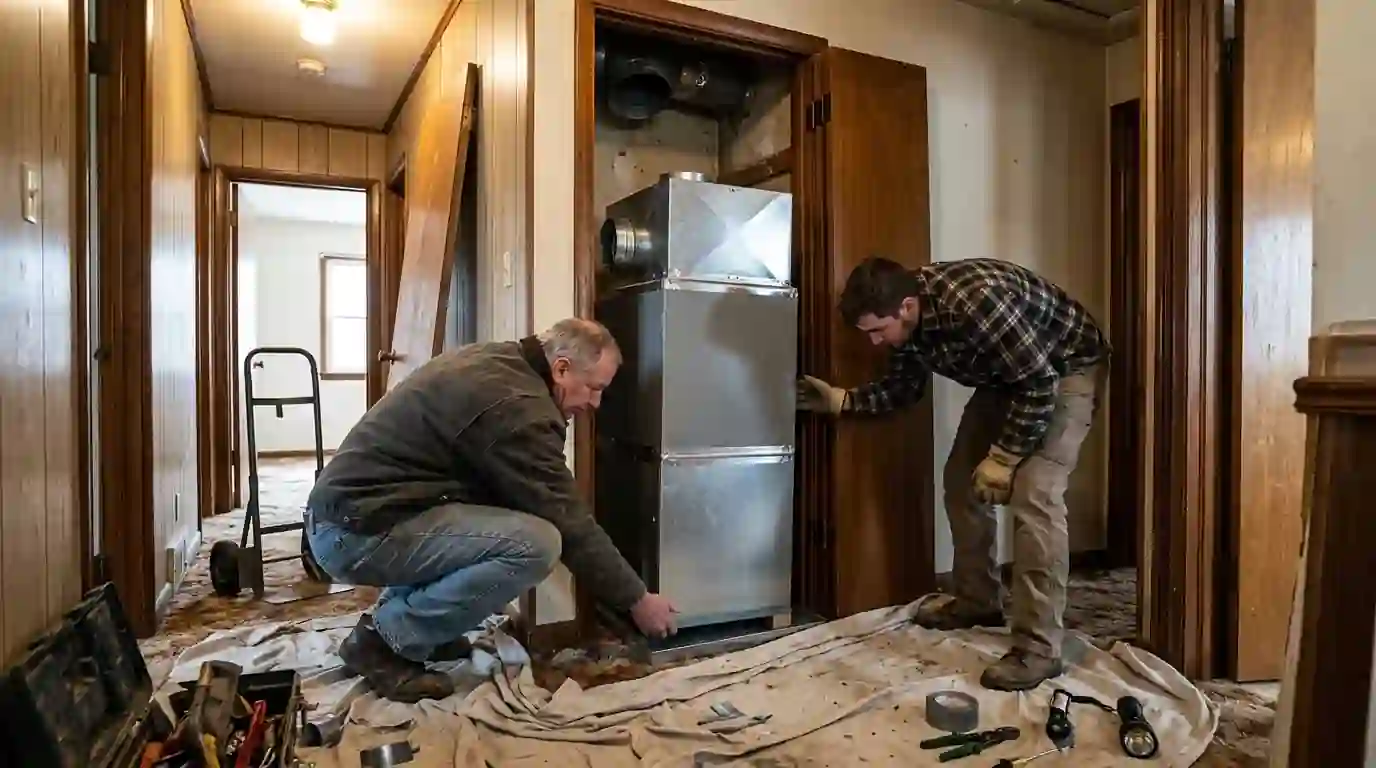
Older brick ranches in Crestwood, Center Point and Huffman often have original crawlspace ducts and small returns, so the duct line on the quote matters there. Early 1900s homes in Avondale and Forest Park may need a chimney liner or new venting with a gas furnace. Newer Shelby County subdivisions in Pelham and Helena usually have sound ducts but two systems to price.
When a repair still makes more sense than a new system
A new system is not always the answer. Many failures are routine repairs on equipment with years left, and we will tell you so when that is the case.
- Capacitor or contactor: $165 to $345, worth fixing on almost any working system.
- Outdoor fan motor: $385 to $715, usually worth fixing on a system under about 12 years old.
- Evaporator coil replacement: $1,380 to $2,940, where age and refrigerant type start to matter.
- Compressor replacement: $1,875 to $3,460, rarely a good spend on an older system.
Two things tip the scale toward replacement. The first is age, since central air systems here commonly last about 12 to 15 years. The second is R-22. Production ended in 2020, so a leak on an R-22 system turns every recharge into a large bill. Our guide on whether to repair or replace an older AC walks through the math.
How to compare two system prices side by side
Prices for a new system can look far apart until you line up what each one includes. Ask every company you talk to the same questions.
- Was the size based on a Manual J load calculation, or on the old unit?
- Are the indoor coil and outdoor unit a matched pair for the new refrigerant?
- What SEER2 level, and what HSPF2 level for a heat pump, does each option reach?
- Is the line set new, or flushed and pressure tested if it is reused?
- Are permits, the thermostat, drain safety switches and removal of the old system included?
- What duct, electrical or gas work is included, and what is priced separately?
A planned replacement in spring or fall usually goes more smoothly than an emergency swap in a July heat wave, because you have time to weigh options. New equipment comes with a manufacturer parts warranty, which we help you register after startup. For typical prices on repairs, tune-ups and other work, see our HVAC cost guide, then call us any hour with questions.
Key takeaways
- Most complete split systems around Birmingham land between $8,640 and $17,980 installed.
- System type, tonnage from a Manual J load calculation and SEER2 level drive the equipment price.
- Ductwork, access, electrical and gas work drive the labor side of the number.
- A capacitor, contactor or fan motor on a sound system is usually worth repairing.
Questions readers ask
Most single-story ranches with usable ducts land near the lower end of each range, starting around $6,380 for a basic heat pump and air handler or $8,640 for an AC and gas furnace pair. Duct repairs, attic access or a panel upgrade push the number up. You get a written price after the home visit.
Close to it, since each floor needs its own equipment sized to its own load. Doing both on one visit saves some setup, and the upstairs system is often smaller. If one system is much younger, replacing only the failing one is a reasonable choice, and we price it both ways.
Stepping up from single-stage equipment near the 14.3 SEER2 minimum to two-stage or variable-speed equipment usually adds a few thousand dollars. The extra buys longer, quieter cycles and better humidity control. Over a long Birmingham cooling season that helps, but power savings alone rarely pay back the difference quickly.
Usually because they cover different work. One may include a load calculation, a matched coil, a new line set, permits and duct sealing, while the other reuses old parts or leaves items out. Line up the size, SEER2 level and included items, and the gap often makes sense.
Services mentioned in this guide
- Complete HVAC System ReplacementOutdoor unit, indoor unit, coil and controls replaced together as one matched system.
- Heat Pump InstallationNew or replacement heat pumps matched to the house, the ductwork and Alabama winters.
- Dual Fuel SystemsA heat pump paired with a gas furnace that takes over on the coldest nights.