Why heat pump air can feel cool even while it heats
A gas furnace sends out air that feels hot the moment it leaves the register. A heat pump works differently. It moves heat from the outdoor air into the house, and the air it delivers is warmer than the room but often cooler than your hand.
So a register that feels lukewarm is not proof of a problem. The better test is the house itself. If the rooms hold the thermostat setting, the heat pump is doing its job, even if the air never feels hot.
Real trouble looks different. The house slips below the setting and keeps falling, the vents blow cold rather than mild air, or the cool air lasts far longer than a few minutes.
The defrost cycle: steam, a quiet fan and a short burst of cool air
In winter the outdoor coil runs colder than the outside air, so moisture freezes on it. Birmingham's damp winter mornings near freezing are prime frost weather. Every so often the heat pump clears that frost by running a defrost cycle.
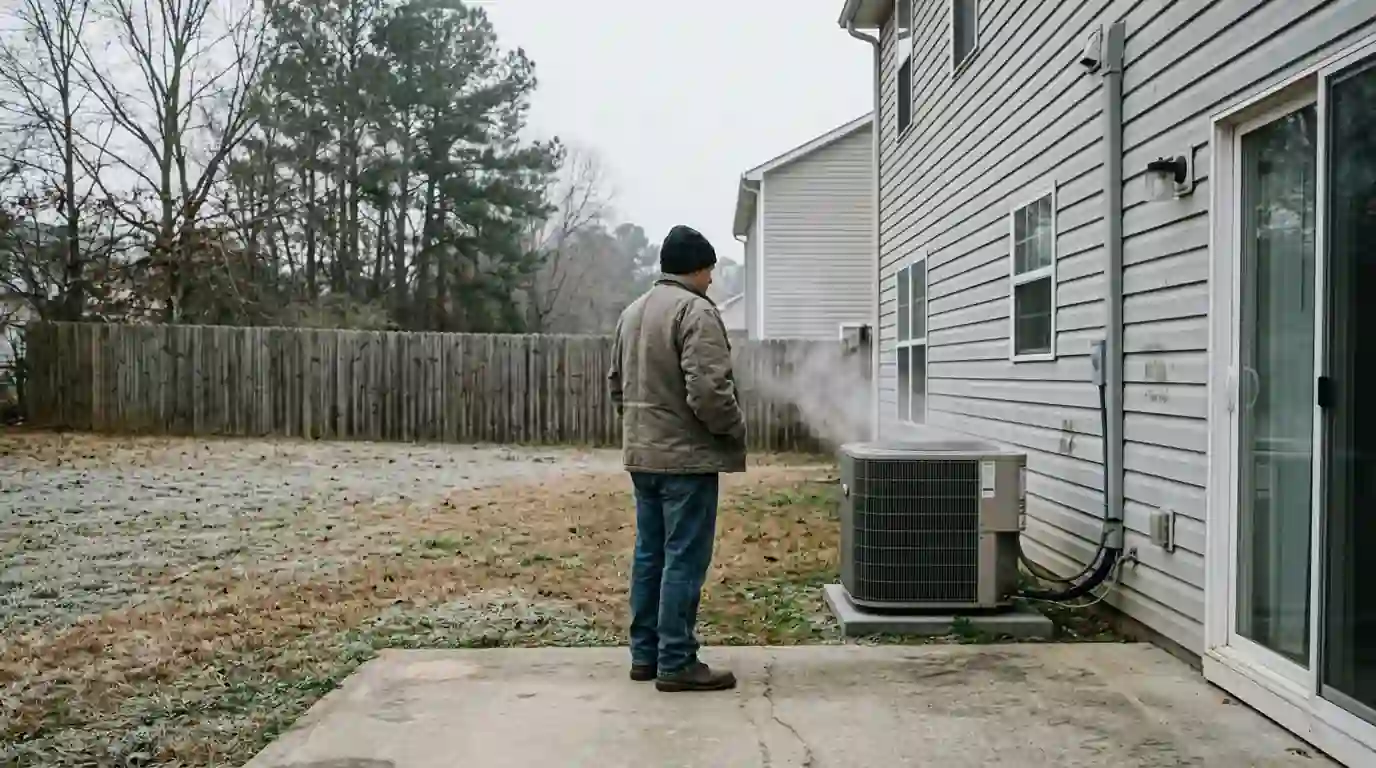
During defrost, the system briefly switches into cooling mode so hot refrigerant flows through the outdoor coil. The outdoor fan stops, and you may hear a whoosh when the valve shifts. A cloud of steam often rises off the unit, which looks alarming but is only melting frost. Inside, the air from the vents may feel cool for a few minutes unless the heat strips come on to temper it.
A normal defrost ends on its own, usually within a few minutes, and the outdoor fan starts again. The coil should look mostly clear afterward. Steam, a pause and a short spell of cooler air, repeated now and then on a cold, damp day, is the system working as designed.
Aux heat and the balance point on a 20 degree night
As the temperature drops, a heat pump produces less heat while the house loses heat faster. The outdoor temperature where those two lines meet is the balance point. Below it, backup heat has to make up the difference, and the thermostat shows that as aux heat.
On a mild 45 degree day, the heat pump carries the house alone. On a 20 degree night during a Birmingham cold snap, it runs nonstop and still needs help. If the backup works, the house holds temperature and the air feels warmer while the strips are on. If it doesn't, the heat pump falls behind and the air turns noticeably cool.
When the heat strips do not engage
Most heat pumps around Birmingham use electric heat strips in the air handler as backup. A burned element, a failed sequencer or relay, a tripped strip breaker or a thermostat wired without an aux heat connection all leave the heat pump on its own. That shows up first on the coldest nights and during defrost, when cool air lasts longer than it should.
Emergency heat is a different setting. It locks out the heat pump and runs only the backup heat. Use it when the outdoor unit has clearly failed, such as being encased in ice or making loud noises, and call for service. Strip heat is the costliest way to warm the house, so use it for days, not weeks. Our heat strip repair page covers the backup side in more detail.
Ice that will not clear from the outdoor unit
Light frost that comes and goes is normal. A thick shell of ice over the coil, ice building up from the base, or a unit that looks like a block of ice is not. Once ice covers the coil, the heat pump can't pull heat from the outdoor air, and the vents blow cool.
The usual causes are a failed defrost board or coil sensor, an outdoor fan that keeps running when it should stop, low refrigerant, or water that can't drain away from the base. Gutters dripping onto the unit and snow or leaves packed around it are common outside culprits.
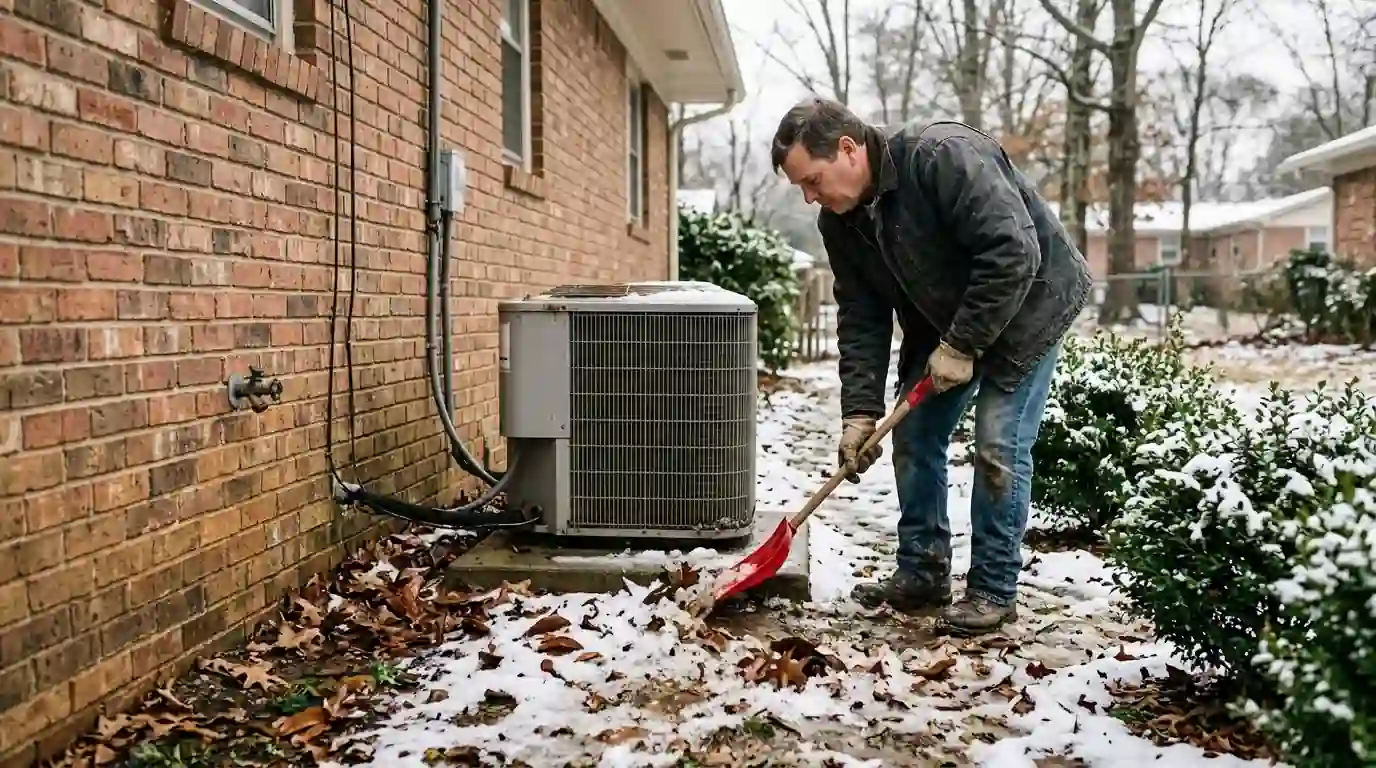
You can clear snow, leaves and debris from around the unit and keep a couple of feet of open space on every side. Don't chip or pry at the ice on the coil, since the fins and tubing damage easily. If ice keeps building after a few defrost cycles, switch to emergency heat and call.
Thermostat mix-ups that turn heat into cooling
Before anything mechanical, look at the thermostat. A mode left on cool after a warm December afternoon, or an auto mode with a cooling set point too close to the heating set point, can send cold air on a winter morning. Schedules and vacation holds can also override what you set.
O/B settings after a new thermostat
Heat pumps use a reversing valve to switch between heating and cooling, and the thermostat tells it which way to go. Most brands energize the valve for cooling through a terminal marked O. Some, including Rheem and Ruud, energize it for heating through a terminal marked B. If a new thermostat is set the wrong way, the heat pump cools when you call for heat.
That's why this problem often appears during the first cold week after a thermostat swap. The fix is usually one setting in the installer menu, labeled O/B or reversing valve. If the wiring itself is unclear, our smart thermostat installation visits set the equipment type, staging and aux heat correctly.
Reversing valve faults and low refrigerant
If the thermostat is right and the vents blow cool for long stretches, the reversing valve may be stuck in the cooling position. Sometimes only the solenoid coil that shifts it has failed, which is a modest repair. A valve body that sticks or leaks inside means a replacement, with the refrigerant recovered first and recharged after.
Low refrigerant causes cool air in heat mode too. With a short charge, the heat pump moves less heat, runs longer, frosts up faster and leans on backup heat more often. A low charge always means a leak, and finding and fixing it is technician work, never a homeowner job. Older heat pumps on R-22 cost far more to recharge, since production ended in 2020.
Both problems often show up as a jump in the Alabama Power bill before the house gets truly cold, because the heat strips quietly cover for the weak heat pump. A heat pump repair visit tests the system in both modes and measures the strips, so we can see which part is actually short on heat.
What you can safely check tonight, and when to call
These checks are safe for any homeowner, and they often solve the problem or at least narrow it down.
- Confirm the thermostat is set to heat, with the set point above room temperature and no schedule overriding it.
- Replace a dirty filter. Low airflow makes heat pump air feel cooler and can trip the heat strips on their limit switches.
- Watch the outdoor unit for five minutes. Steam with a stopped fan is defrost. A running fan under a solid coat of ice is not.
- Check the breakers. If the outdoor unit or heat strip breaker has tripped, reset it once. If it trips again, leave it off.
- Clear snow and leaves from around the outdoor unit, without touching the coil.
Call us if cold air lasts more than a few minutes at a time, ice keeps building, aux heat shows on mild days or the house falls behind the thermostat during a cold snap. An outdoor unit iced solid is the moment for emergency heat until a technician arrives. Most heat pump repairs here fall within $189 to $947, and you get the price before work starts. We answer 24/7.
Key takeaways
- Steam, a stopped outdoor fan and a few minutes of cool air usually mean a normal defrost cycle.
- On 20 degree nights a heat pump needs aux heat, and failed heat strips leave the air cool.
- After a new thermostat, check the mode and the O/B setting first.
- Ice that will not clear or cold air that lasts is a repair call. Use emergency heat and call us.
Questions readers ask
That is usually the defrost cycle. The system briefly reverses to melt frost off the outdoor coil, the outdoor fan stops and the indoor air can feel cool until it switches back. If it lasts much longer than a few minutes or repeats every few minutes, have it checked.
Yes, in most cases. Steam rises when the defrost cycle melts frost on the warm outdoor coil, often with a whoosh and a pause in the outdoor fan. Smoke, a burning smell or grinding noises are different, so turn the system off and call if you notice any of those.
The thermostat may have the wrong reversing valve setting, O or B, or it may be set up as a conventional system instead of a heat pump. Either one can make the system cool when you call for heat. Check the installer menu, or call us to set it up correctly.
Below the balance point, the heat pump can't keep up alone, so it runs nonstop and the air feels milder. Backup heat should fill the gap. If the house keeps falling behind or the air feels cold rather than mild, the heat strips may not be coming on.
Services mentioned in this guide
- Heat Pump RepairStuck in defrost, iced over, cold air in heat mode or a reversing valve that will not switch.
- Electric Furnace and Heat Strip RepairAir handlers with heat strips that blow cool air, trip breakers or smell hot.
- Smart Thermostat InstallationThermostats wired, configured and matched to heat pumps, dual fuel and multi-stage systems.